Comparing 30B MoE models for edge inference on humanoid robots
TL;DR
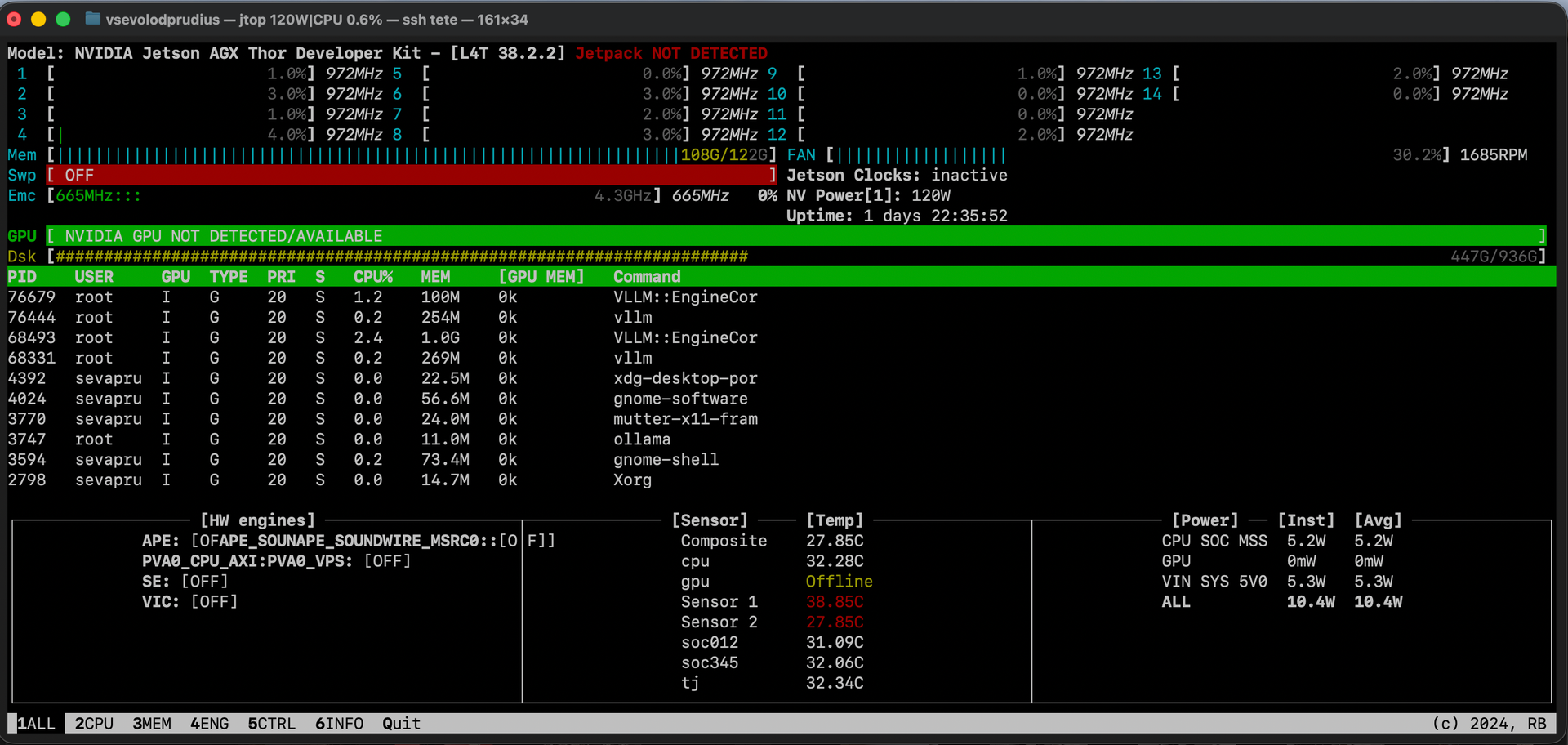
We benchmarked two 30-billion parameter Mixture-of-Experts models on NVIDIA Jetson Thor in 120W power-limited mode.
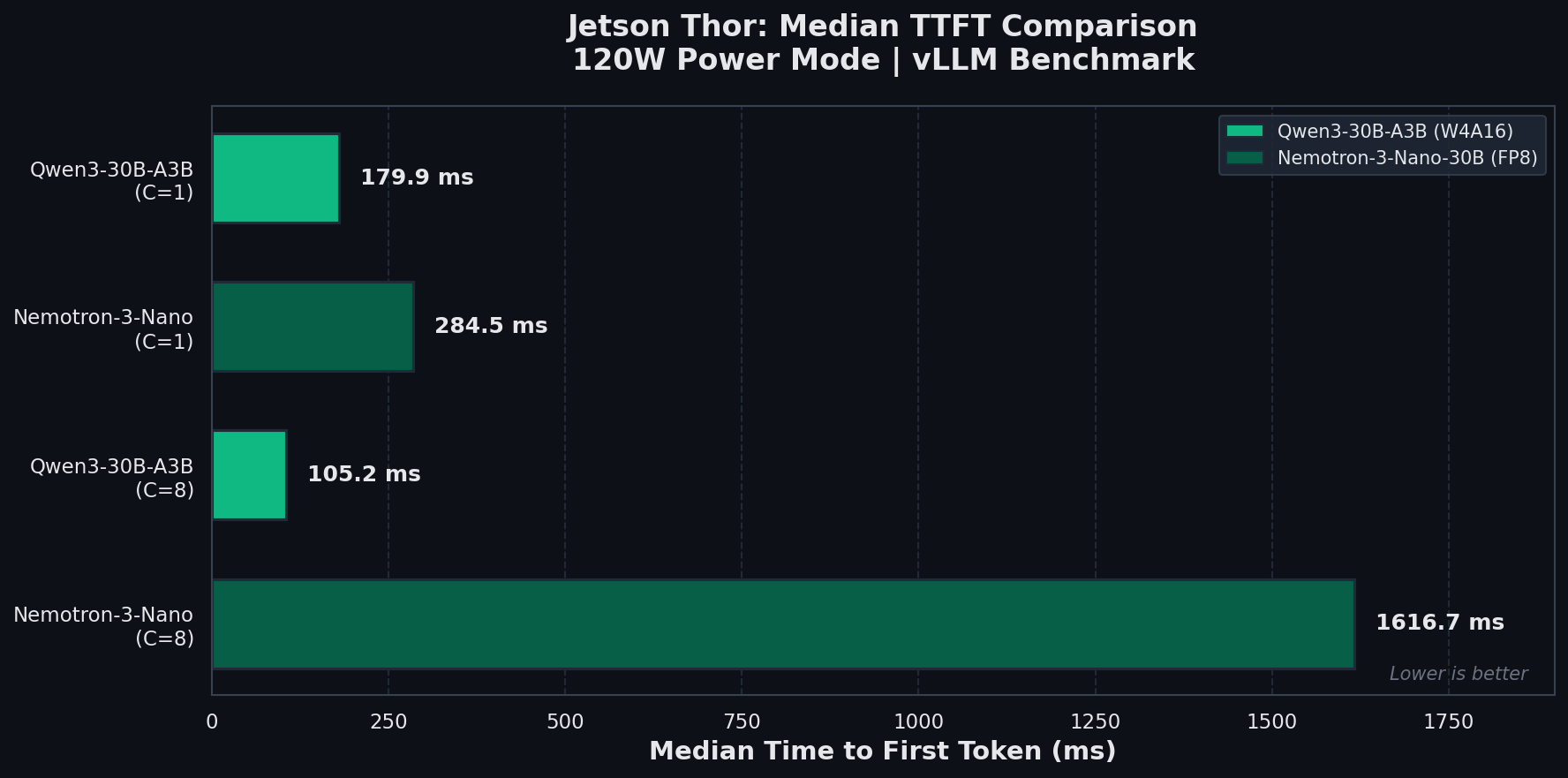
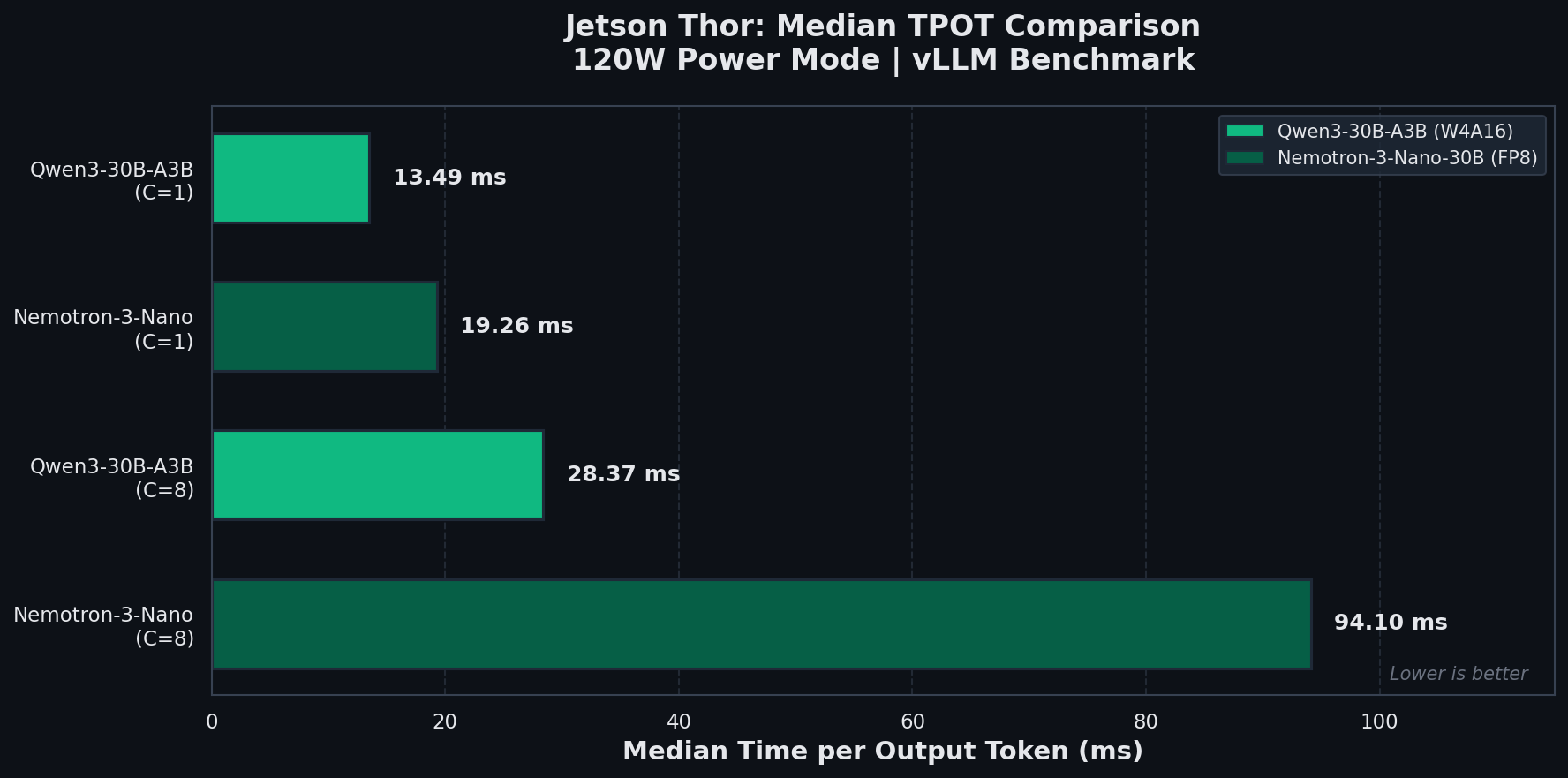
For real-time robotics applications, Qwen3-30B-A3B delivers 1.6x faster Time to First Token and 1.4x faster token generation than Nemotron-3-Nano at single concurrency. Here's the full breakdown.
Here is quick results so you don't need to scroll over the whole report:
Why This Matters for Robotics
When your humanoid robot needs to make real-time decisions, every millisecond counts. Time to First Token (TTFT) is the critical metric for interactive agents — it's the latency between sending a prompt and receiving the first token of the response. While the model is "thinking," your robot potentially stands frozen without commands.
For embodied AI agents running locally on edge devices, you need:
- Low TTFT for responsive interactions
- Consistent latency (low P99) for predictable behavior
- Reasonable throughput for complex reasoning tasks
- Power efficiency for sustained operation
We tested two comparable MoE architectures using NVIDIA's recommended benchmarking protocol.
Test Environment
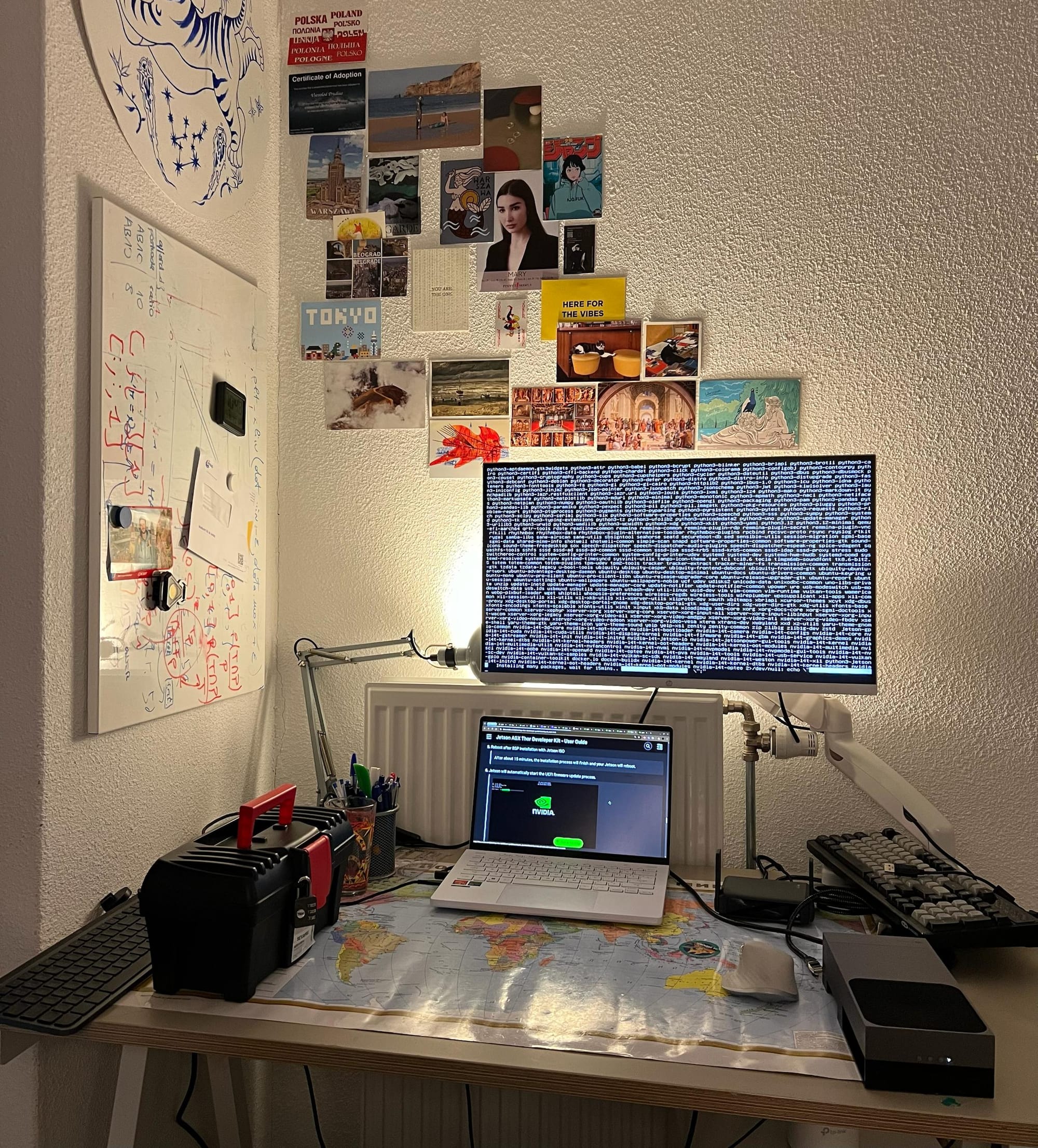
Hardware Configuration
| Parameter | Value |
|---|---|
| Device | NVIDIA Jetson Thor |
| Architecture | NVIDIA Thor SoC (Blackwell GPU) |
| Unified Memory | 128GB |
| Power Mode | 120W (Limited) |
| Cooling | Active cooling solution |
⚡ Why 120W? For embedded robotics applications, we deliberately limit power consumption to ensure thermal stability and extended operational lifetime. Running at full power on edge devices leads to thermal throttling and reduced component longevity.
Benchmark Protocol
We followed the standard NVIDIA Jetson AI Lab GenAI Benchmarking Protocol with vLLM serving benchmarks.
| Parameter | Value |
|---|---|
| Framework | vLLM (Jetson Thor optimized build) |
| Dataset | Random tokens |
| Input Length | 512 tokens |
| Output Length | 330 tokens |
| Test Prompts | 50 |
| Concurrency Levels | 1, 8 |
Models Under Test
Both models were loaded simultaneously into memory using Docker containers, simulating a real-world scenario where multiple models might be available for different tasks.
Model Specifications
| Specification | Qwen3-30B-A3B | Nemotron-3-Nano-30B |
|---|---|---|
| Architecture | Mixture of Experts (MoE) | Mixture of Experts (MoE) |
| Total Parameters | 30B | 30B |
| Active Parameters | 3B | 3B |
| Quantization | W4A16 | FP8 |
Models were tested in the isolated Docker containers based on
image: ghcr.io/nvidia-ai-iot/vllm:latest-jetson-thor
Example of a benchmark commands:
# Qwen3-30B-A3B Test (Concurrency=1)
vllm bench serve \
  --dataset-name random \
  --model RedHatAI/Qwen3-30B-A3B-quantized.w4a16 \
  --num-prompts 50 \
  --percentile-metrics ttft,tpot,itl,e2el \
  --random-input-len 512 \
  --random-output-len 330 \
  --max-concurrency 1 \
  --port 8867

# Nemotron-3-Nano Test (Concurrency=1)
vllm bench serve \
  --dataset-name random \
  --model nvidia/NVIDIA-Nemotron-3-Nano-30B-A3B-FP8 \
  --num-prompts 50 \
  --percentile-metrics ttft,tpot,itl,e2el \
  --random-input-len 512 \
  --random-output-len 330 \
  --max-concurrency 1 \
  --port 8866
Results: Time to First Token (TTFT)
The critical metric for real-time robotics agents.
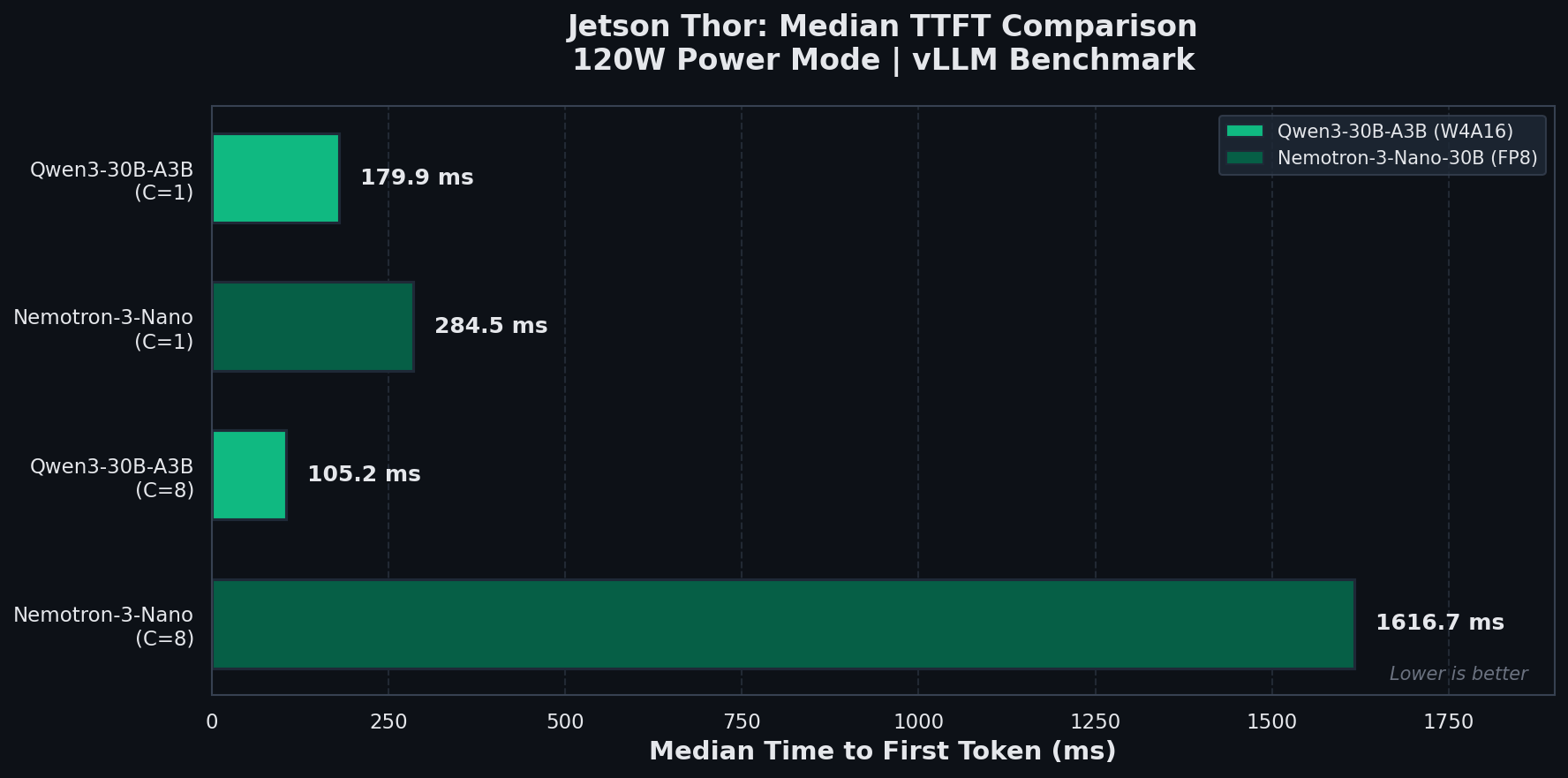
TTFT Detailed Comparison
| Concurrency | Model | Mean TTFT | Median TTFT | P99 TTFT |
|---|---|---|---|---|
| C=1 | Qwen3-30B-A3B | 125.70 ms | 179.92 ms | 188.12 ms |
| C=1 | Nemotron-3-Nano | 398.58 ms | 284.52 ms | 709.21 ms |
| C=8 | Qwen3-30B-A3B | 104.85 ms | 105.23 ms | 158.32 ms |
| C=8 | Nemotron-3-Nano | 1,486.48 ms | 1,616.69 ms | 2,597.72 ms |
🏆 Winner: Qwen3-30B-A3B with 180ms median TTFT at C=1 — that's 1.6x faster than Nemotron's result. At C=8, the gap widens to 15x.
⚠️ Note on Concurrency: For edge robotics deployments, C=1 results are most relevant — humanoid robots typically process one inference request at a time. We include C=8 results for completeness, but they're less applicable to real-world robotics scenarios where requests arrive sequentially.
Results: Generation Latency
How fast does each model generate tokens after the first one?
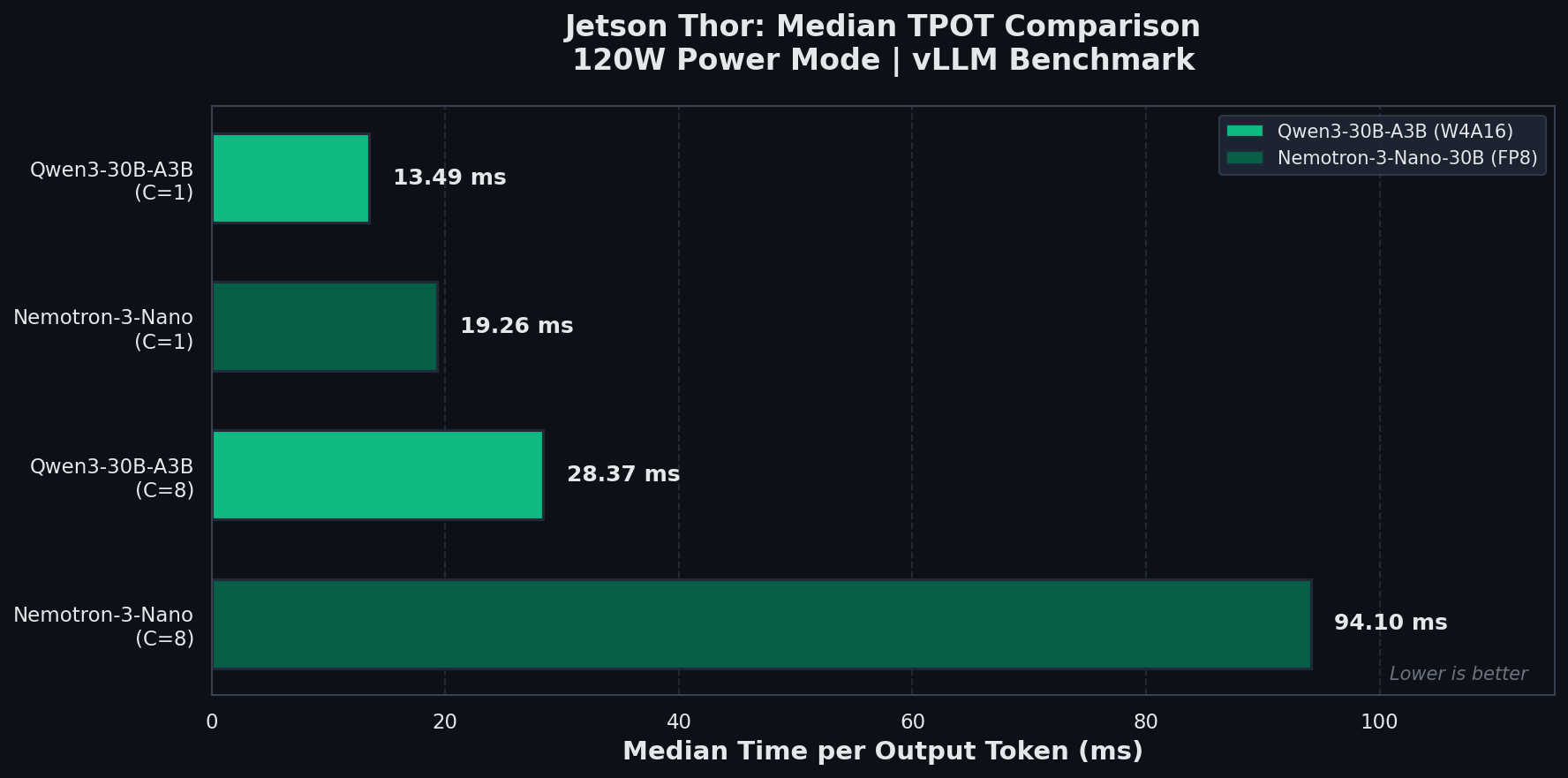
Time per Output Token (TPOT)
| Concurrency | Model | Mean TPOT | Median TPOT | P99 TPOT |
|---|---|---|---|---|
| C=1 | Qwen3-30B-A3B | 13.49 ms | 13.49 ms | 13.59 ms |
| C=1 | Nemotron-3-Nano | 23.39 ms | 19.26 ms | 35.00 ms |
| C=8 | Qwen3-30B-A3B | 27.53 ms | 28.37 ms | 29.27 ms |
| C=8 | Nemotron-3-Nano | 82.25 ms | 94.10 ms | 106.18 ms |
⚡ Qwen3's TPOT is 1.4x faster than Nemotron at C=1 (13.49ms vs 19.26ms).
Inter-token Latency (ITL)
| Concurrency | Model | Mean ITL | Median ITL | P99 ITL |
|---|---|---|---|---|
| C=1 | Qwen3-30B-A3B | 13.49 ms | 13.44 ms | 14.64 ms |
| C=1 | Nemotron-3-Nano | 23.40 ms | 19.32 ms | 35.92 ms |
| C=8 | Qwen3-30B-A3B | 27.53 ms | 28.14 ms | 31.09 ms |
| C=8 | Nemotron-3-Nano | 82.25 ms | 92.64 ms | 108.79 ms |
Results: Token Throughput
Output Token Throughput (tok/s)
| Concurrency | Model | Output Throughput | Peak Throughput | Total Throughput |
|---|---|---|---|---|
| C=1 | Qwen3-30B-A3B | 72.31 tok/s | 75.00 tok/s | 184.49 tok/s |
| C=1 | Nemotron-3-Nano | 40.76 tok/s | 53.00 tok/s | 104.01 tok/s |
| C=8 | Qwen3-30B-A3B | 269.22 tok/s | 320.00 tok/s | 686.91 tok/s |
| C=8 | Nemotron-3-Nano | 89.30 tok/s | 176.00 tok/s | 227.85 tok/s |
📈 Qwen3 delivers 1.8x higher throughput at C=1 and 3x higher throughput at C=8.
Results: End-to-End Latency
E2E Latency for Complete Response (512 in → 330 out tokens)
| Concurrency | Model | Mean E2EL | Median E2EL | P99 E2EL |
|---|---|---|---|---|
| C=1 | Qwen3-30B-A3B | 4,563 ms | 4,611 ms | 4,654 ms |
| C=1 | Nemotron-3-Nano | 8,094 ms | 6,620 ms | 12,218 ms |
| C=8 | Qwen3-30B-A3B | 9,161 ms | 9,415 ms | 9,710 ms |
| C=8 | Nemotron-3-Nano | 28,548 ms | 32,175 ms | 36,094 ms |
🎯 Qwen3 completes full responses in 4.6s vs Nemotron's 6.6s at C=1.
Quick Comparison Summary
Head-to-Head: C=1 (Primary Robotics Scenario)
| Metric | Qwen3-30B-A3B | Nemotron-3-Nano | Winner | Improvement |
|---|---|---|---|---|
| Median TTFT | 179.92 ms | 284.52 ms | Qwen3 | 1.6x faster |
| P99 TTFT | 188.12 ms | 709.21 ms | Qwen3 | 3.8x faster |
| Median TPOT | 13.49 ms | 19.26 ms | Qwen3 | 1.4x faster |
| Output Throughput | 72.31 tok/s | 40.76 tok/s | Qwen3 | 1.8x higher |
| Median E2EL | 4,611 ms | 6,620 ms | Qwen3 | 1.4x faster |
| P99 E2EL | 4,654 ms | 12,218 ms | Qwen3 | 2.6x faster |
| GPU Memory | 30% | 50% | Qwen3 | 40% less |
Head-to-Head: C=8 (Batch Processing Scenario)
| Metric | Qwen3-30B-A3B | Nemotron-3-Nano | Winner | Improvement |
|---|---|---|---|---|
| Median TTFT | 105.23 ms | 1,616.69 ms | Qwen3 | 15x faster |
| Median TPOT | 28.37 ms | 94.10 ms | Qwen3 | 3.3x faster |
| Output Throughput | 269.22 tok/s | 89.30 tok/s | Qwen3 | 3x higher |
| Median E2EL | 9,415 ms | 32,175 ms | Qwen3 | 3.4x faster |
Analysis: Which Model for Humanoid Robotics?
For Real-Time Agent Tasks
Qwen3-30B-A3B is the clear winner for robotics applications requiring:
- Fast Response Initiation — 180ms TTFT at C=1 means your robot starts responding almost instantly. For human-robot interaction, anything under 200ms feels "immediate."
- Consistent Latency — Qwen3's P99 TTFT (188ms) is almost identical to its median, while Nemotron's P99 (709ms) is 2.5x its median. Predictability matters for real-time control loops.
- Memory Efficiency — Running at 30% GPU memory utilization leaves headroom for vision models, sensor processing, and motion planning on the same device.
- Faster Token Generation — 13.49ms TPOT means smoother streaming responses and faster completion times.
When to Consider Nemotron
Nemotron-3-Nano might be preferred when:
- You need NVIDIA's native reasoning parser for chain-of-thought tasks
- FP8 inference precision is required over W4A16 quantization
- You're already in an NVIDIA-centric deployment pipeline
Real-World Robotics Implications
| Use Case | Recommended Model | Rationale |
|---|---|---|
| Voice interaction | Qwen3 | Sub-200ms TTFT feels natural |
| Tool calling / Function execution | Qwen3 | Lower latency for action chains |
| Complex reasoning tasks | Nemotron | Native reasoning parser support |
| Multi-model deployment | Qwen3 | Lower memory footprint (30% vs 50%) |
| Vision-Language-Action | Qwen3 | Leaves GPU headroom for vision |
| Real-time decision making | Qwen3 | Consistent P99 latency |
Conclusion
For local real-time inference on humanoid robots, Qwen3-30B-A3B outperforms Nemotron-3-Nano across all key metrics on Jetson Thor at 120W:
- 1.6x faster median TTFT at C=1 (primary robotics scenario)
- 3.8x more consistent latency (P99 vs median ratio)
- 1.8x higher token throughput
- 40% lower GPU memory usage
The W4A16 quantization of Qwen3 proves to be more efficient than Nemotron's FP8 implementation on this hardware, likely due to better memory bandwidth utilization and optimized kernels in the Jetson Thor vLLM build.
For robotics engineers deploying LLM-powered agents on edge devices, Qwen3-30B-A3B provides the responsiveness needed for natural human-robot interaction while leaving computational headroom for perception and control systems.
P.S. FLASHINFER as an Attention Backend
Using AttentionBackendEnum.FLASHINFER is suggested as a performance upgrade for any model interference running on Jetson/Nvidia devices.
Enabling FLASHINFER led to nothing cause it's already quite optimal, but you'll see the difference with a bigger context window.
Resources
Benchmarked on NVIDIA Jetson Thor @ 120W power mode. Your results may vary based on power settings, thermal conditions, and system load.
Hope you have a good day,
Vsevolod Prudius, Sobaka Team.